

Propfirmito may earn a commission, at no additional cost to you, when you sign up through our links. Our scoring remains independent. Full disclosure ›
2.5%OFF Vest Markets ★ 2.5% off on all challenges · From $10 ($500) · Last checked November 10, 2026Code2IPROPFIRMITOAffiliate link · we may earn a commission
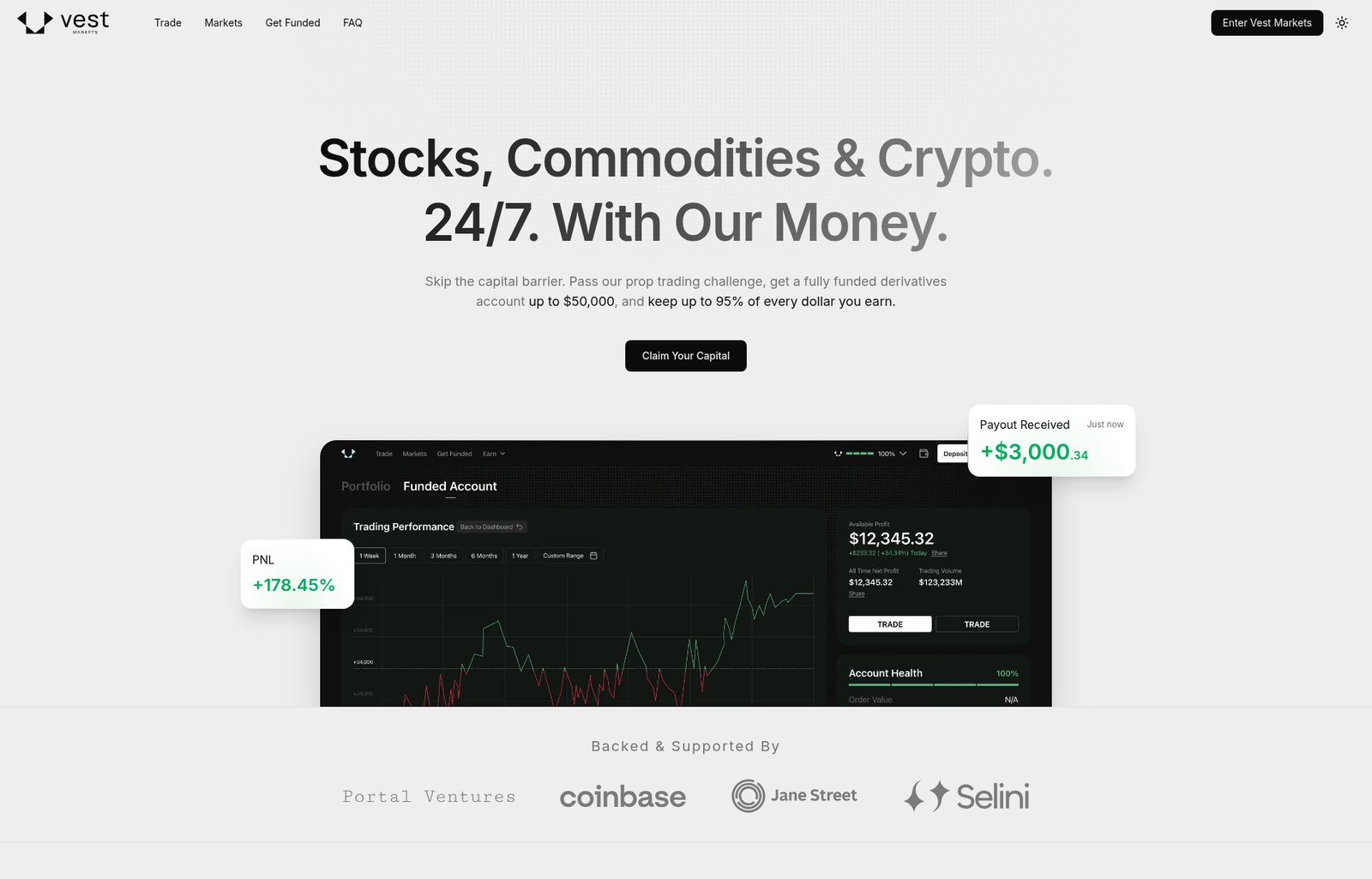
Vest Markets is a trading platform for perpetual futures: contracts that follow the price of a stock, an index, a commodity, a currency pair or a coin and never expire. Crypto trades around the clock and the other markets nearly so, everything is margined in USDC, and the platform runs its own funded-account program, Vest Capital, where a one-time fee from $10 buys an account of $500 to $50,000 and you keep 80% to 95% of the profit you claim. This guide explains what it is, how it differs from a futures prop firm, how a trade is placed, what it costs and where the catches are.
Everything below comes from Vest Markets’ own website, app, FAQ, documentation and terms, read on 10 November 2026. I have not traded a Vest account. Propfirmito is a Vest Markets affiliate, as the banner above says, and that does not change what is written here. Where two of Vest’s own pages disagree, I show both.
Vest Markets in one minute
| Question | Short answer |
|---|---|
| What is it? | A perpetual futures platform with its own funded-account program, Vest Capital |
| What can you trade? | 64 markets in the published leverage table: 41 stocks and ETFs, 7 currency pairs, 5 crypto, 4 indices, 4 metals, 3 energy |
| What is the money? | USDC, for collateral and for payouts |
| Margin | Cross margin only |
| Leverage | Up to 100x with your own money, up to 75x on a funded account, set per market |
| Funded account sizes | $500 to $50,000 |
| Ways to get funded | Instant (no evaluation), 1-Step, 2-Step, or a custom build |
| One-time fee | $10 to $2,000 Instant · $75 to $745 1-Step · $15 to $175 2-Step |
| Profit split | 95% on Instant, 80% on the standard evaluations |
| Loss rule | One static max drawdown; a daily loss limit only if you choose one |
| Getting paid | Claim Profit on demand, credited in 24 hours, no minimum |
| Platform | Vest’s own web app; no MetaTrader, no NinjaTrader, no API on funded accounts |
| Who runs the program | Vest Exchange Inc., a Panama corporation; the site is © Vest Labs Inc. |
| Our code | 2IPROPFIRMITO, 2.5% off the fee |
What Vest Markets actually is
Two things live under one name, and beginners mix them up.
The first is an exchange. You open an account, deposit USDC, and trade perpetual futures with your own money. Vest calls this your Primary Account. Leverage goes up to 100x depending on the market, and if a trade goes badly enough the platform liquidates the position, as on any leveraged venue.
The second is Vest Capital, the funded-account program. You do not deposit anything. You pay a one-time fee, receive a Funded Account of a fixed size, trade it under a short set of risk rules, and keep a share of the profit you claim. In fact a Funded Account cannot receive deposits at all. This is the part that makes Vest Markets a prop firm, and it is the part most readers of this site care about.
Both accounts sit in the same app, use the same order book and show the same markets. The difference is whose risk it is and which rules apply.
Who is behind it? The documentation says the Vest Labs team has prior experience in proprietary market making and names its backers: Coinbase, Jane Street, Selini, Amber, QCP, BBH, IVC and executives from Citadel, BlackRock and HRT. The home page adds Portal Ventures. The site does not name a founder, a chief executive or an office address, so I will not either.
Perpetual futures, explained for someone who has never traded one
A normal futures contract has an expiry month. When it ends you close it or move to the next one. A perpetual contract, or “perp”, has no expiry. You can hold it for a minute or a year.
That raises a question: if the contract never settles against the real asset, what keeps its price close to the real thing? The answer is funding. Once an hour, traders on one side pay traders on the other. When the perp trades above the underlying price, funding is positive and longs pay shorts. When it trades below, shorts pay longs. Vest’s documentation is explicit that funding moves between traders and is not an exchange fee.
Three prices appear on every market, and each has a job:
- Index Price is the real-time price of the underlying. During market hours Vest builds it from exchanges such as NASDAQ, NYSE, CME and BlueOcean ATS.
- Mid Price is what your unrealized profit and your balance are calculated on.
- Mark Price is used for liquidations only.
Every contract is “USDC-margined and linear”, which is a technical way of saying the maths is simple. On the S&P 500 market, one unit gains or loses 1 USDC for each point the price moves. No multipliers to memorise.
Two details matter if you come from regular futures. The index and commodity perps follow CME futures, so they still roll to the next contract month, but Vest does it for you during the CME maintenance window and adjusts entry and liquidation prices internally, so a roll does not change your profit or loss. The S&P perp, for example, moves to the March 2027 contract on 15 December 2026. And prices are fenced: a perp cannot trade more than a set distance from its index price (0.25% on the four index markets, 0.50% on gold, crude oil, Bitcoin and Ether, 1% on NVDA).
Vest Markets vs a futures prop firm
This is the comparison most readers need, so here it is side by side. The futures column uses Topstep and MyFundedFutures, two of the futures firms we score, as the examples.
| A CME futures prop firm (Topstep, MyFundedFutures) | Vest Markets (Vest Capital) | |
|---|---|---|
| What you trade | Exchange-listed futures contracts with expiry months | Perpetual contracts on Vest’s own venue that track those futures, plus stocks, FX and crypto |
| Where you trade | A third-party platform: TopstepX at Topstep; NinjaTrader, Tradovate, TradingView and others at MyFundedFutures | Vest’s own web app, in a browser |
| Position size | Whole contracts: one Micro E-mini S&P is $5 a point | Units: one ES unit is 1 USDC a point, so 5 units equal one Micro |
| Hours | The futures session; neither firm allows holding over the weekend | Crypto 24/7; index and commodity perps lock only from Friday 5 PM ET to Sunday 6 PM ET; holding over the weekend is allowed |
| Cost of holding | Commissions | Taker fee plus hourly funding |
| Max loss rule | End-of-day trailing at both firms ($2,000 on a $50,000 account) | Static: 6% on evaluations ($3,000 on $50,000), fixed on day one |
| Consistency rule | 55% target at Topstep, 50% on MyFundedFutures Rapid | None |
| Minimum trading days | 2 at Topstep and on MyFundedFutures Rapid | None |
| Fee model | Monthly subscription at Topstep; one-time at MyFundedFutures | One-time, no subscription |
| Account sizes | $50,000 to $150,000 at Topstep; $25,000 to $150,000 at MyFundedFutures | $500 to $50,000 |
| How you are paid | Through each firm’s own payout process | USDC to your Vest balance within 24 hours, then an on-chain withdrawal |
| Automated strategies | Allowed at both | Not possible: no API on funded accounts |
Three differences deserve more than a table cell.
The drawdown does not follow you. At a firm with a trailing max loss, the level you must not touch rises as your balance rises. On Vest it is set once, as a percentage of starting capital, and never moves. On a $25,000 evaluation account the floor is $23,500 on the first day and on the hundredth.
You are not trading the CME contract. You trade Vest’s perpetual version of it, on Vest’s order book, priced from an index. That brings hourly funding, Vest’s own trading schedule and Vest’s own leverage caps. It also means the firm that sells you the account runs the market you trade on.
Size is small and the platform is fixed. The largest account is $50,000 and you can hold up to ten live ones. There is no MetaTrader, no NinjaTrader and no API for funded accounts. If your method needs automation, stop here.
For the two example firms in detail, see our Topstep overview and MyFundedFutures overview.
What you can trade, and when
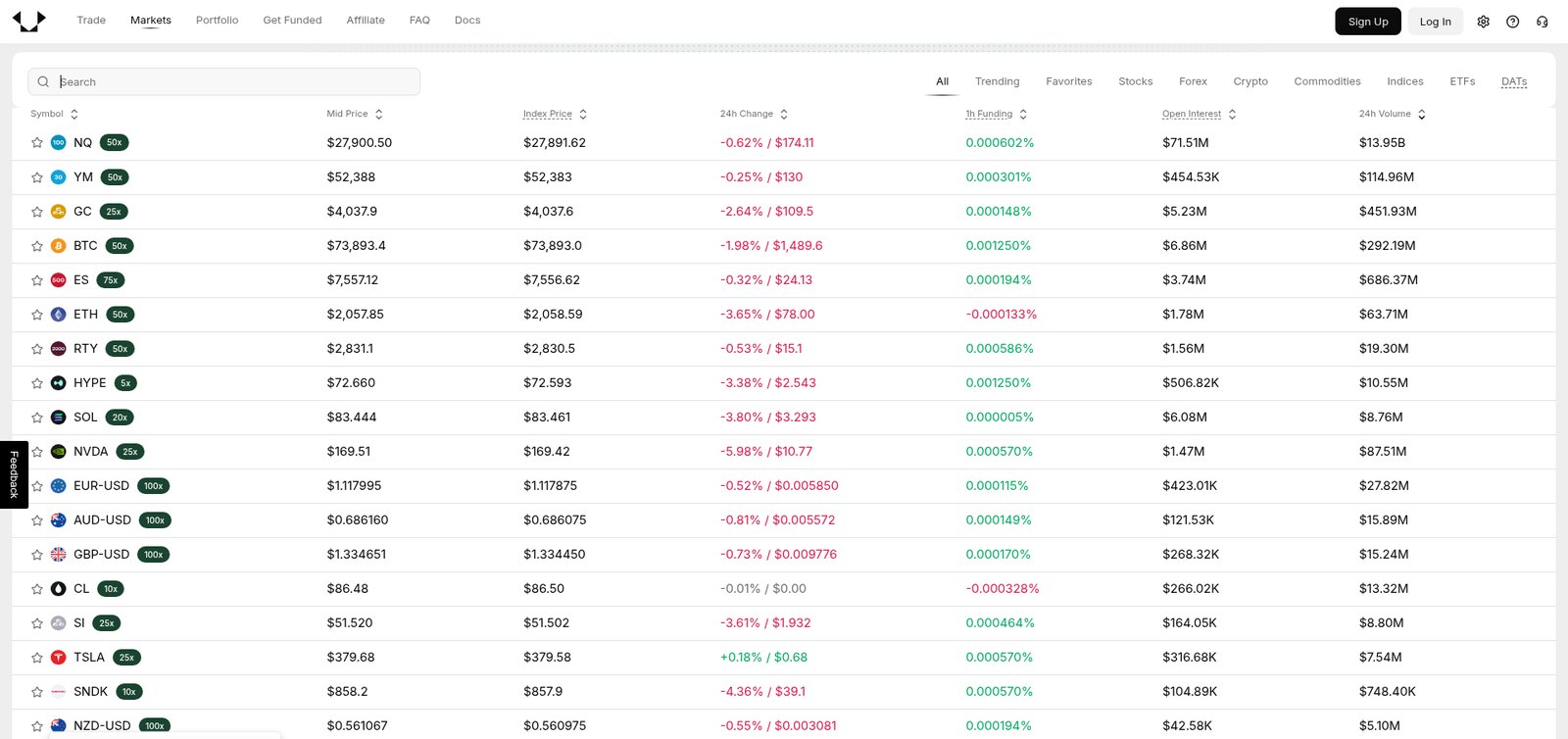
The leverage table in the documentation lists 64 markets. The caps below are the maximum leverage on a funded account; your own Primary Account gets more on most of them.
| Asset class | Markets | Max leverage on a funded account |
|---|---|---|
| Indices | ES (S&P 500), NQ (Nasdaq 100), RTY (Russell 2000), YM (Dow) | ES 75x; NQ, RTY, YM 50x |
| Currencies | EUR, GBP, JPY, AUD, CAD, CHF, NZD against the dollar | 75x |
| Crypto | BTC, ETH, SOL, HYPE, XRP | BTC 25x, ETH 15x, SOL 10x, HYPE 5x, XRP not available |
| Metals | Gold, silver, copper, platinum | Gold 25x, silver 15x, copper and platinum 5x |
| Energy | WTI crude, Brent, natural gas | Crude 10x, Brent and gas 5x |
| Stocks and ETFs | 41 names, among them AAPL, MSFT, NVDA, TSLA, AMZN, META, SPY, QQQ | Mostly 5x; NVDA 25x; TSLA, INTC, MU, SNDK and SPCX 10x |
A note on consistency between Vest’s own pages. The documentation says funded accounts go up to 75x and that only XRP is excluded. The FAQ still says “up to 50x” and lists HYPE as unavailable too. The per-market table is the more detailed and the more recent of the two, so I use it, but check the leverage shown on the market itself before you size a trade.
Trading hours follow the underlying asset:
| Market | Schedule |
|---|---|
| Crypto | Continuous, weekends included |
| Index and commodity perps | Open through the daily CME maintenance hour; locked from Friday 5:00 PM ET to Sunday 6:00 PM ET |
| Single stocks | Regular, pre-market, extended and overnight sessions Monday to Friday; locked from Friday 8:00 PM ET to Sunday 8:00 PM ET |
| Currencies | Monday to Friday; locked over the weekend |
A position you hold into a lock stays open. You cannot close it, add to it or adjust it until the market reopens, and it can gap.
Three ways to get funded, and a builder
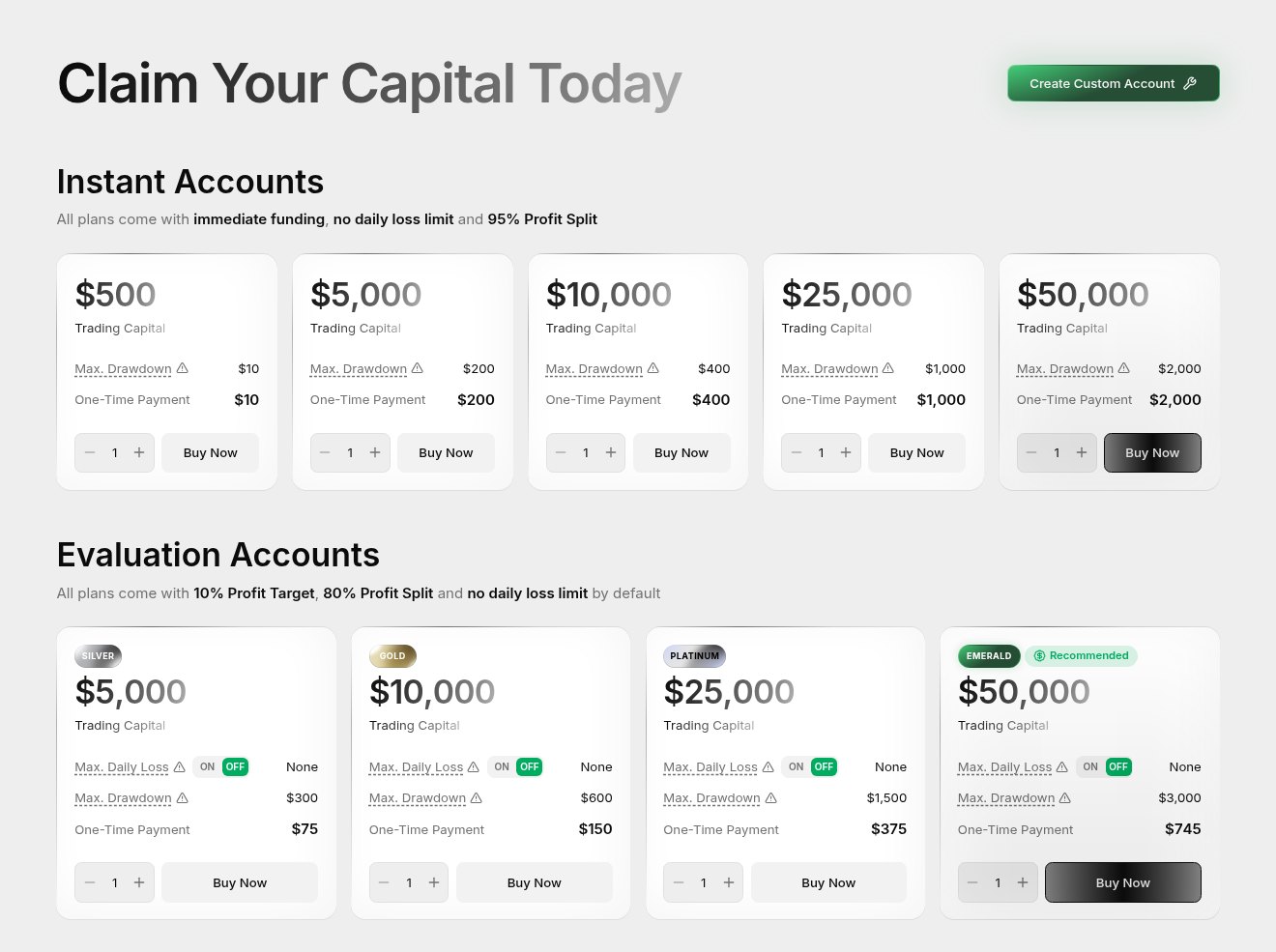
Instant Account. No evaluation. The account is live when your payment clears, there is no profit target, and the split is a flat 95%. One rule sets the price: your payment equals your max drawdown. Pay $400 for a $10,000 account and you can lose $400 of equity before it closes.
1-Step evaluation. You trade a simulated account until you reach a 10% profit target without touching a 6% static drawdown. Pass, and a live account of the same size opens straight away with the same rules. The standard cards have no daily loss limit and an 80% split.
2-Step evaluation. Two targets, 10% and then 5%, with a 3% daily loss limit, the same 6% max drawdown and an 80% split. It is much cheaper than the 1-Step because it asks more of you.
| Program | Size | One-time fee | With 2IPROPFIRMITO | Profit target | Max drawdown | Daily loss limit | Split |
|---|---|---|---|---|---|---|---|
| Instant | $500 | $10 | $9.75 | None | $10 (2%) | None | 95% |
| Instant | $5,000 | $200 | $195 | None | $200 (4%) | None | 95% |
| Instant | $10,000 | $400 | $390 | None | $400 (4%) | None | 95% |
| Instant | $25,000 | $1,000 | $975 | None | $1,000 (4%) | None | 95% |
| Instant | $50,000 | $2,000 | $1,950 | None | $2,000 (4%) | None | 95% |
| 1-Step Silver | $5,000 | $75 | $73.13 | 10% | $300 (6%) | None | 80% |
| 1-Step Gold | $10,000 | $150 | $146.25 | 10% | $600 (6%) | None | 80% |
| 1-Step Platinum | $25,000 | $375 | $365.63 | 10% | $1,500 (6%) | None | 80% |
| 1-Step Emerald | $50,000 | $745 | $726.38 | 10% | $3,000 (6%) | None | 80% |
| 2-Step Silver | $5,000 | $15 | $14.63 | 10%, then 5% | $300 (6%) | 3% | 80% |
| 2-Step Gold | $10,000 | $35 | $34.13 | 10%, then 5% | $600 (6%) | 3% | 80% |
| 2-Step Platinum | $25,000 | $90 | $87.75 | 10%, then 5% | $1,500 (6%) | 3% | 80% |
| 2-Step Emerald | $50,000 | $175 | $170.63 | 10%, then 5% | $3,000 (6%) | 3% | 80% |
Then there is Create Custom Account, a builder with four sliders for a 1-Step account: profit target from 5% to 20%, max drawdown from 6% to 8%, daily loss limit from none to 5%, and profit split from 70% to 95%. The price moves as you move them. According to the pricing matrix in the documentation, a higher target and a daily loss limit both make the account cheaper and a higher split makes it dearer: the cheapest build listed there is a 20% target with a 3% daily limit and an 80% split, at $25, $50 and $130 for the Silver, Gold and Platinum sizes. The documentation warns that its prices can lag and that the live page is the record, so read the builder before you buy.
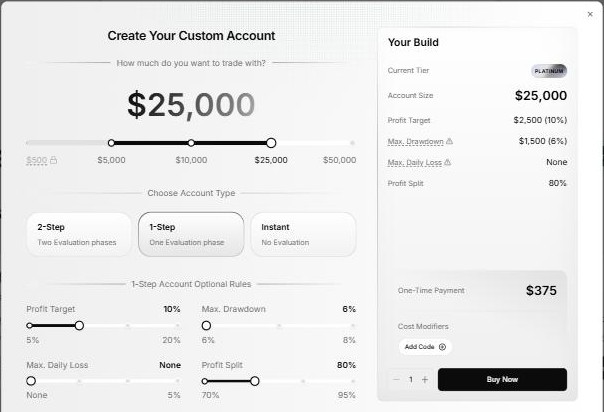
Which one for a beginner? The $500 Instant Account costs $10 and the Silver 2-Step costs $15. Either is a cheap way to learn the app with real rules attached. I would not start with a $745 Emerald.
The rules in plain words
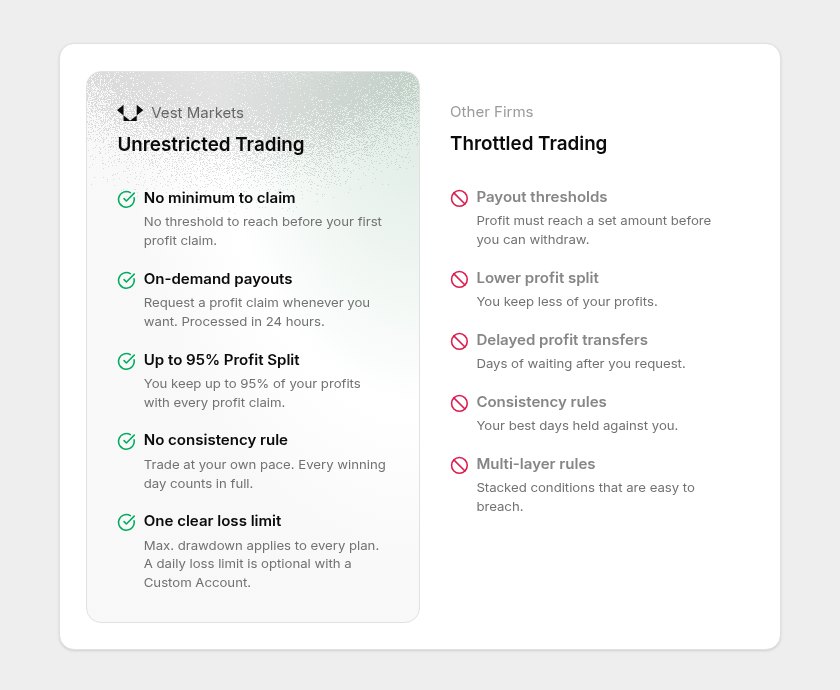
Max drawdown. Every funded account has one. It is fixed when the account is created, as a percentage of the starting capital, and it never trails. Vest checks it against your account value at every moment, open positions included. A $10,000 Instant Account bought for $400 closes if your account value reaches $9,600. A $25,000 evaluation account closes at $23,500.
Daily loss limit. Off by default on the 1-Step cards, never present on Instant, fixed at 3% on the 2-Step, optional in the builder. If you have one, it resets at 20:00 ET each day. The floor is your balance at the reset, without open profit, minus your percentage. Open profit does not raise it, but your current equity, open positions included, is measured against it. A withdrawal lowers the floor by the full amount the same day.
What is not there. No minimum number of trading days. No time limit. No consistency rule. No ban on trading the news, and the FAQ allows scalping and high-frequency approaches in so many words. You can hold overnight and through the weekend. The one behaviour the FAQ prohibits is abusing or coordinating across funded accounts, for example taking opposite sides of the same market on two of them.
What happens on a breach. The account closes immediately and permanently. No warning, no grace period, no reset. You buy a new one. The same applies in the evaluation and when live.
The rule beginners miss: Temporary Leverage Limits. “News trading allowed” has a condition attached. From five minutes before to one minute after Nonfarm Payrolls, CPI, PPI and FOMC releases, and from Friday 4:10 PM ET until the market reopens after the weekend, the maximum leverage on some markets drops for Vest Capital accounts: 5x on the four index perps, 5x on all currency pairs, 3x on gold and silver. Around a company’s earnings release its stock is limited to 1x. A position above the reduced limit is shrunk to fit it, and its limit orders are cancelled. If your account is more than 1% below its starting capital at that moment, the position is closed in full instead. If your account can cover the larger margin, nothing is touched. The limit applies to each position, not to the account as a whole, so read that page of the documentation before you hold size into a release or a weekend.
The Fail Price. The order form shows an estimated Fail Price for each trade: the price at which you would hit your drawdown floor, or your daily limit if that comes first. On a one-rule account it is the single most useful number on the screen.
How to start, step by step
- Create an account. Go to the app and sign up with an email address, a Google account or a crypto wallet. More than 500 wallets are supported and the FAQ says it takes under a minute. There is no username and password.
- Choose your path. Open Get Funded. Pick an Instant size, a 1-Step tier, or open Create Custom Account for a 2-Step or a tailored build.
- Enter the code. The price section has an Enter Discount Code field, and the builder has an Add Code button. Our code is 2IPROPFIRMITO and takes 2.5% off; the details are on our Vest Markets discount page.
- Pay once. Checkout runs through Stripe by card. To pay with crypto, select USD and look under More options. There is no subscription and no renewal. Sending USDC to your Primary Account does not buy a Funded Account.
- Start trading. An Instant Account is live when the payment clears. An evaluation starts in the Evaluation Phase and goes live when you reach the target.
You may be asked to verify your identity and residence before purchase, access or payment. You must be at least 18.
If you only want the exchange, with your own money, the route is shorter: sign up, deposit at least 1 USDC (by direct transfer on Base or Arbitrum One, or by card through the built-in onramp), and trade.
How to place a trade on Vest Markets
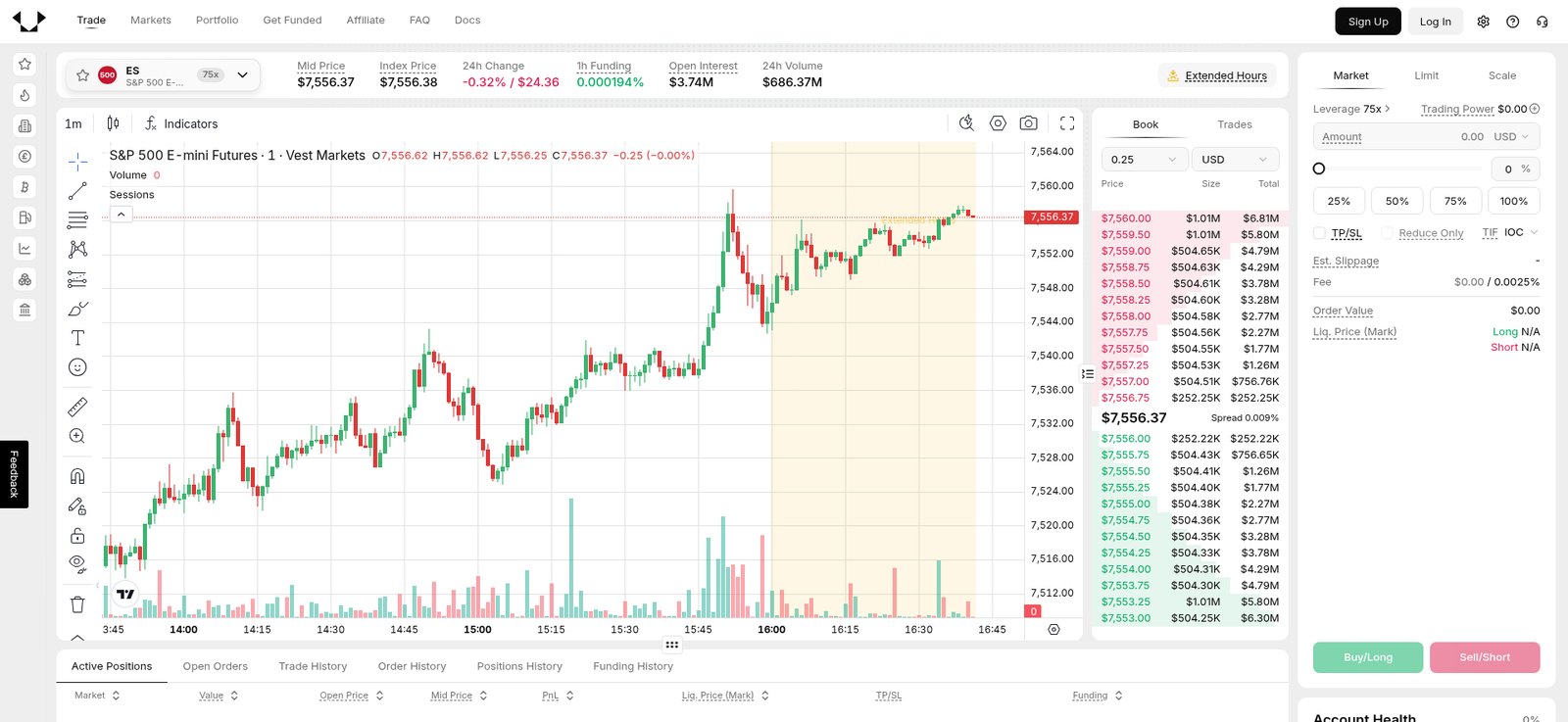
The screen has four parts. The bar at the top shows the market with its mid price, index price, 24-hour change, one-hour funding rate, open interest and volume. The chart sits on the left. The order book and recent trades are in the middle. The order form is on the right, with an Account Health panel under it. Along the bottom are your active positions, open orders and history, funding payments included.
A first trade, in order:
- Pick a market. Use the selector at the top left or the Markets page. Markets can be filtered by asset class and added to a watchlist.
- Pick an order type. Market fills now at the best available price. Limit fills at your price or better, or waits. Scale spreads a larger order over a range of prices.
- Set the amount. The Amount field works in USDC or in market units. In USDC it is the size of the position, not the margin you post. To copy a futures position, switch to units and use the table below.
- Check the leverage. Click the leverage indicator at the top of the form and move the slider. Leverage changes how much margin the trade uses. It does not change your profit or loss per point on a fixed size.
- Add a stop and a target. Tick TP/SL to attach a take-profit and a stop-loss. Each can be a market or a limit order. A stop triggers at a price; it does not guarantee that price.
- Read the preview. Before you click, the form shows the order value, the fee, the estimated slippage and the Fail Price for a long and for a short.
- Buy/Long or Sell/Short. The position appears under Active Positions with live profit and loss, funding and the price at which it fails. You can change the stop and target from there or from the Portfolio page.
If you think in futures contracts, this is the conversion Vest publishes:
| Futures position | Vest market | Vest quantity | Profit or loss per point |
|---|---|---|---|
| 1 Micro E-mini S&P 500 (MES) | ES | 5 units | 5 USDC |
| 1 E-mini S&P 500 (ES) | ES | 50 units | 50 USDC |
| 1 Micro E-mini Nasdaq 100 (MNQ) | NQ | 2 units | 2 USDC |
| 1 E-mini Nasdaq 100 (NQ) | NQ | 20 units | 20 USDC |
Vest’s own example makes the sizing concrete. With ES at 6,000, five units are a 30,000 USDC position. At 10x leverage, the position needs about 3,000 USDC of margin. A 10-point rise makes 50 USDC on a long and a 10-point fall loses 50. A stop 20 points away risks 5 × 20 = 100 USDC before fees and slippage. On a $5,000 Silver account with a $300 drawdown, that single number tells you how many such trades you can lose: three.
A few order options are worth knowing. Reduce Only stops an order from flipping you to the other side by accident. Time in force can be GTC (rests until filled or cancelled), IOC (fills what it can and cancels the rest), FOK (all or nothing) or ALO (post only). Market orders default to IOC, limit orders to GTC.
What trading costs
The trading fee. Resting orders (maker) pay nothing on any market. Orders that take liquidity pay 0.01% on most markets, 0.0025% on index and commodity perps and 0.0015% on the seven currency pairs. On the 30,000 USDC ES position above, a market order costs about 75 cents to open and the same to close.
Funding. It settles every hour while the position is open. On 10 November the ES market showed a one-hour funding rate of 0.000194%, which on a 30,000 USDC position is about 6 cents an hour, paid by longs to shorts. The rate changes with demand and can turn negative, in which case shorts pay. Vest’s documentation gives a bigger example: a $1.25 million Nasdaq position at an average premium of 0.12% pays $31.25 for that hour. Funding is charged on the size of the position, so lowering your leverage does not lower it. If you hold for days, add it up.
Spread and slippage. The FAQ is frank that realised profit can come in below the unrealised figure you saw, because of the spread and slippage at the moment you close.
In the evaluation. Fees and funding are simulated like the rest of the account, so nothing is collected, but they reduce your balance and count toward your drawdown exactly as a loss would.
Getting paid
Money leaves in two steps and beginners confuse them.
Step one, Claim Profit. From the Portfolio page of a live funded account you submit a Claim Profit request. Your share (95% on Instant, 80% on the standard evaluations) is credited to your Primary Account in 24 hours. There is no minimum, no cap on the amount and no limit on how often you claim. You may have to close open positions first, and a claim cannot be reversed.
Step two, Withdraw. From the Primary Account you send USDC to an external wallet. You type the address, choose the chain and the amount; the minimum is 1 USDC. Email and Google accounts withdraw on Base or Arbitrum One. Nothing is sent back automatically to the address you deposited from, and a withdrawal cannot be recovered once sent, so check the address twice.
On timing, Vest’s pages differ. The FAQ says withdrawals are processed at once until your rolling 24-hour total reaches $50,000, and that only the amount above it waits 24 hours. The Withdrawals page in the documentation currently carries a notice that all platform withdrawals have a 24-hour processing period. Plan for the slower of the two.
You need a crypto wallet that accepts USDC to get money out. If you have never used one, sort that out before your first claim, not after.
The advantages
- One static drawdown. It never trails and is known on day one.
- No daily loss limit unless you want one, on the Instant and the standard 1-Step.
- No minimum days, no time limit, no consistency rule.
- A $10 entry. The $500 Instant Account, and $15 for a $5,000 2-Step.
- A 95% split on Instant, fixed at purchase and applied at every claim.
- Claims on demand, credited in 24 hours, with no threshold.
- Many markets on one balance: index, stock, currency, commodity and crypto perps under the same rules.
- Long hours. Crypto never closes and the index perps trade through the CME maintenance hour.
- Low trading fees, with no maker fee at all.
- A futures conversion table and a Fail Price in the order form, which is more help than most platforms give a newcomer.
The drawbacks
- Every account is described as simulated in the terms (next section).
- A young public record. The Trustpilot profile, claimed in October 2025, showed 2.9 out of 5 from 21 reviews on 10 November 2026.
- The firm runs the venue you trade on, and the terms acknowledge conflicts of interest.
- A breach is final. No reset and no second chance on the same account.
- Temporary Leverage Limits can shrink or close a position around major releases, earnings and weekends.
- No API, no bots, no outside platform on funded accounts.
- Small accounts. $50,000 is the ceiling per account, and most stocks are capped at 5x.
- Funding adds up if you hold positions for days.
- Payouts are in USDC to a crypto wallet. There is no bank transfer.
- Refunds are narrow. Card purchases only, within 3 days, and only if no trade has been opened. Accounts bought with crypto or with your Vest balance are not refundable.
- Vest’s own pages do not always agree (leverage, HYPE, withdrawal timing, account sizes in the documentation). The terms and the live price page are what count.
What the terms say
Read this part even if you skip the rest.
The Prop Trading Terms of Service, last updated on 28 October 2026, are provided by Vest Exchange Inc., a Panama corporation. They open with a disclosure that all accounts, Instant Funded Accounts included, are simulated, and that no real trading capital is credited to you. The fee buys access to the program, not a trading account. What you are paid is called “Program compensation”, calculated from your simulated results under the program rules. The firm may or may not place real trades based on yours, and says that this does not change what you are owed.
The same terms disclose conflicts of interest: the company earns from the fees it keeps, controls the simulation settings and may receive incentives from third parties. They also set the limits per user (ten Instant accounts and one hundred evaluation accounts at a time) and prohibit using a VPN to get around restrictions.
Much of this is how prop firms are structured today, and I would not single Vest out for it. I point it out because the documentation still describes a live funded account as backed by real capital, while the terms, which are the contract, say simulated. When the two differ, the terms win.
Who Vest Markets suits, and who should skip it
It suits a trader who wants simple rules and can live inside one fixed drawdown; someone who already trades crypto perps and understands funding; a futures day trader curious about a static drawdown who is happy to test with $10 or $15; and anyone who wants index, stock and crypto exposure on the same account.
Skip it if you need MetaTrader, NinjaTrader or an automated strategy; if you want $100,000 or more in one account; if you want a long payout history before paying a fee; if you rely on resets; or if you are not comfortable being paid in USDC.
Where it is available
The terms name six prohibited jurisdictions: Cuba, North Korea, Iran, Russia, Syria and the Philippines. The Government of Venezuela and anyone on a sanctions list are excluded as well. The United States is not on the list.
One dated note: the November competition
Until 30 November 2026 at 5:00 PM ET Vest is running a trading competition with $155,000 in prizes for live funded accounts of $25,000 and $50,000 bought on or after 1 November. Entry is automatic. The rules are in the documentation.
Frequently asked questions
What is Vest Markets?
Vest Markets is a trading platform for perpetual futures on stocks, indices, commodities, currencies and crypto, all margined in USDC on one cross-margin account. It also runs Vest Capital, a funded-account program in which you pay a one-time fee and keep 80% to 95% of the profit you claim.
Is Vest Markets a prop firm or an exchange?
Both. With a Primary Account you trade your own USDC on the exchange. With a Vest Capital Funded Account you pay a one-time fee and trade an account of $500 to $50,000 under the program’s risk rules.
What is the difference between Vest Markets and a futures prop firm?
A futures prop firm gives you exchange-listed futures on a third-party platform. On Vest you trade perpetual contracts on Vest’s own venue, with hourly funding, a static max drawdown, no consistency rule, no minimum days, accounts up to $50,000 and payouts in USDC.
How much does a Vest Capital account cost?
Instant Accounts cost $10, $200, $400, $1,000 and $2,000 for $500, $5,000, $10,000, $25,000 and $50,000. Standard 1-Step evaluations cost $75, $150, $375 and $745 for $5,000 to $50,000. The 2-Step costs $15, $35, $90 and $175. Code 2IPROPFIRMITO takes 2.5% off.
What is the max drawdown on Vest Markets?
It is static. On evaluation accounts it is 6% of starting capital on the standard cards. On Instant Accounts it equals your payment: 2% on the $500 account and 4% on the larger ones. Your account value, open positions included, must stay above that floor.
Is there a daily loss limit?
Not on Instant Accounts and not on the standard 1-Step cards. The 2-Step has a 3% daily loss limit, and the custom builder lets you add one. When present it resets at 20:00 ET.
Can I trade the news and hold over the weekend?
Yes to both. Around Nonfarm Payrolls, CPI, PPI and FOMC releases, around a company’s earnings, and from Friday 4:10 PM ET over the weekend, maximum leverage on some markets is temporarily reduced on Vest Capital accounts, and oversized positions can be reduced or closed.
How do I get paid?
Submit a Claim Profit request from your live funded account. Your share is credited to your Primary Account in 24 hours with no minimum. From there you withdraw USDC to a crypto wallet, with a minimum of 1 USDC.
Can I use bots or an API?
No. API trading is not available on any funded account, in the evaluation or live.
Can I get a refund?
Only for an account bought by card, within 3 days of purchase, and only if no trade has been opened. Accounts bought with cryptocurrency or with your Vest balance are not refundable, and failing an evaluation does not qualify.
Is a Vest funded account real capital?
The terms state that all accounts, Instant Funded Accounts included, are simulated, and that what you receive is Program compensation calculated from your simulated results.
Which countries cannot use Vest Capital?
Cuba, North Korea, Iran, Russia, Syria and the Philippines are prohibited jurisdictions under the terms, together with the Government of Venezuela and sanctioned persons.
The bottom line
Vest Markets is easy to describe and unusual to find: an exchange for perpetual futures that sells funded accounts on its own markets, with one static drawdown, no daily limit by default, no minimum days, claims on demand and a $10 way in. Set against that, the firm is young, the terms call every account simulated, the company behind the program is in Panama, payouts are in USDC, and nothing can be automated.
On our board Vest Markets scores 67.9/100, grade B, and it is so far the only firm in our Crypto/Perps class. If you want to try it, start with the smallest account, learn the Fail Price and the Temporary Leverage Limits before you size up, and treat your first claim as the real test. For what the program gets right, what is strange and who should skip it, read our verdict on Vest Markets.
Sources (all read 10 November 2026): vestmarkets.com · next.vestmarkets.com/vest-capital · next.vestmarkets.com/faq · next.vestmarkets.com/prop-terms-of-service · next.vestmarkets.com/markets · next.vestmarkets.com/trade · docs.vestmarkets.com (About, Getting Started, Deposits, Withdrawals, Markets, Cross Margin & Leverage, Order Types, Funding, Perpetual Contract Specifications, Temporary Leverage Limits, Exchange Notices, Vest Capital Overview, Account Tiers, Loss Limits, Claiming Profit, Trading Competition, Refund Policy) · trustpilot.com/review/vestmarkets.com.
Related on Propfirmito: Vest Markets verdict · Vest Markets overview · Vest Markets discount code · Find your prop firm · Our methodology · Corrections log
Last verified: 10 November 2026
Found this useful? Add Propfirmito as a preferred source and see it more often in your Google results.
Add as Preferred Source